
VIP member

RXCT Rotating Core Tomography System
Geotek, a British company, is the designer and manufacturer of the world's best-selling core equipment MSCL (Multi Sensor Core Logger Core Comprehensi
Product details
Geotek Company Introduction:
Geotek, a British company, is the designer and manufacturer of the world's best-selling core equipment MSCL (Multi Sensor Core Logger Core Comprehensive Testing System, also known as Multi Parameter Core Scanner). Almost every laboratory engaged in core research work in the world (scientific research, engineering exploration, oil drilling, etc.) has installed MSCL, with over 220 users. MSCL has very stable, reliable, and durable performance, suitable for both laboratory and field use. It has been widely used in core libraries, geological key laboratories, temporary field laboratories, offshore survey ships, deep-sea drilling ships, and engineering ships around the world. Geotek is the most commonly used core analysis equipment by scientists. Wherever there are rock cores on Earth, there are Geotek products.
If a core is worth taking, it's worth logging... Core is precious, data is priceless.

Rotating 3D Core Tomography System
Introduction:
Geotek has designed and manufactured a series of digital 2D and 3D X-ray tomography imaging systems, which are widely used in the field of geological science, including oil and gas fields, marine and nearshore geological research, paleoclimate research, geotechnical mechanics research, and more. The X-ray imaging system platform from Geodek can meet the scanning requirements of users for a range of sizes of core samples, with high cost-effectiveness and strong practicality.
Geotek's X-ray core tomography system is used to scan samples such as intact core, cut core, flat core, or small sidewall core without damaging the core structure, obtaining two-dimensional or three-dimensional images of the interior of the core and providing valuable data on the internal structure of the core. This data is used to study the quality of rock cores or provide valuable information for further research and analysis.
Main features:
1、 Specially designed for core research:
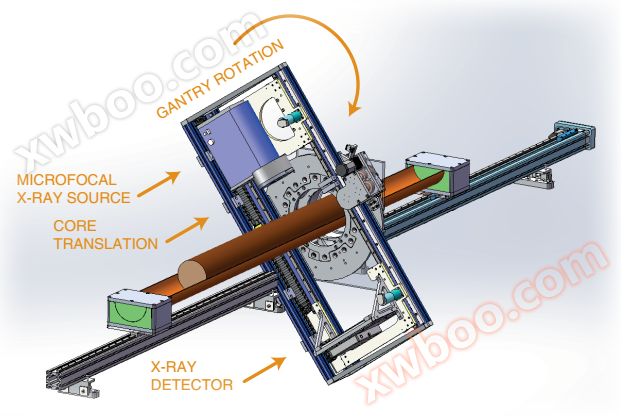
The introduction of the Geotek core fault scanning system has solved the problem of inaccurate measurement of the internal 3D structure of rock cores. The maximum length of the core that can be scanned is 150cm, and the maximum diameter is 15cm. Other samples with diameters less than 15cm can also be scanned. The positions of the X-ray source and detector can be adjusted as needed to accommodate different core sizes and achieve the best image results.
2、 System security:
The system adopts a fully shielded design, which complies with safety regulations in the United States and the United Kingdom, and can be used in ordinary laboratory environments without the need for special shielding. When the system is working, the warning indicator lights up. When the shielded cabinet door of the system is in the open state, the internal safety locking device can prevent the opening of the X-ray source, ensuring safety.
3、 X-ray digital image:
A digital flat panel detector outputs 16 bit grayscale TIFF images, which can be converted into the desired JPEG or other image formats using software from Geotek.
4、 No need for slicing (Slabbing):
Without damaging the sample, the system has X-ray intensity compensation and software correction functions, allowing the equipment to scan complete or cut rock cores or other samples, and obtain high-quality images of various parts of the entire rock core without the need for slicing processing.
5、 Rotation method: Sensor rotation
The rotation of the sensor module can be automatically controlled by the computer to detect the internal structure of the rock core or record continuous rotational scanning videos. The rotation of the rock core allows users to clearly understand the internal three-dimensional structure of the rock core and determine the optimal scanning direction and position.
6、 Automatic control scanning or interactive manual control scanning:
After the core is placed on the equipment, the scanning work (linear scanning or rotary scanning) can be automatically carried out under the control of the computer. In addition, users can manually control the scanning process of the rock core under X-rays, manually control the horizontal and rotation of the rock core, and view and check the scanned images in real time, and then decide whether to perform a detailed scan of a certain position.
7、 High resolution X-ray 3D imaging
The analysis of images and the study of core structure require a complete 3D internal structure of the core. The XCT system from Geodek can obtain high-resolution 3D internal structural information of rock cores. Geotek provides CT related software to reconstruct images, generate orthogonal and circular images, and also generate videos. The CT data output format is a 16 bit TIFF file, which can be loaded and viewed through any CT viewer and image analysis software.
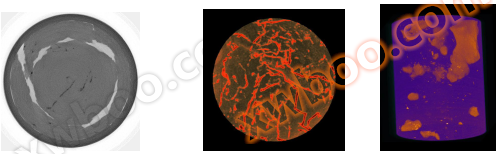
The above image shows the axial core structure image (3D CT reconstruction)
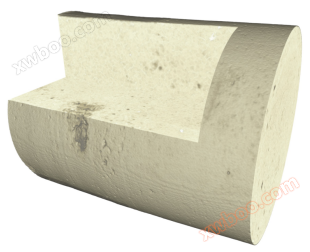
3D reconstruction image of complete dolomite core sample with a resolution of 80 μ m
8、 Laminography X-ray Layered Photography Technology
Sometimes it is not necessary to perform a complete 3D imaging scan of the core, so Geotek has developed a new imaging analysis technique: X-ray layered photography. This layering technique extracts a series of slice 3D information in the transverse depth of the rock core (along the X-ray source detector axis), without the need for 3D reconstruction of 2D scan data, greatly reducing the time and data volume of complete 3D scanning. Similar to optical imaging, only the features in each slice can be focused on. Each slice is related to depth, so it can be used to determine the depth and size of gravel, IRD raft debris, or shells in the core sample.
The following example is a sediment core sample from a lake, showing multiple parallel layers. In the example, we can see that gravel appears in the 2cm depth slice of image C, but not in the 1cm depth slice. This technology is highly suitable for identifying raft ice debris IRD or gravel in cut or intact rock cores.
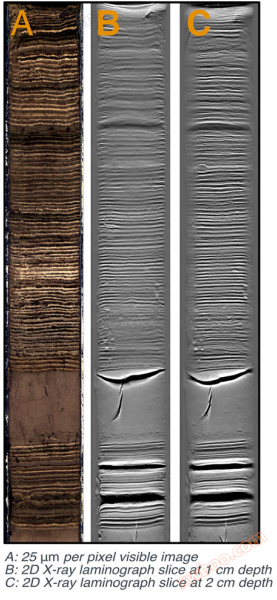
A: 25 μ m resolution visible light imaging; B: 2D X-ray slice at a depth of 1cm; C: 2D X-ray slice at a depth of 2cm
Online inquiry
-
Contacts
-
Company
-
Telephone
-
Email
-
WeChat
-
Verification Code
-
Message Content
-